
Featured Clinician: Heather Abraham, SUNY University At Buffalo Law School
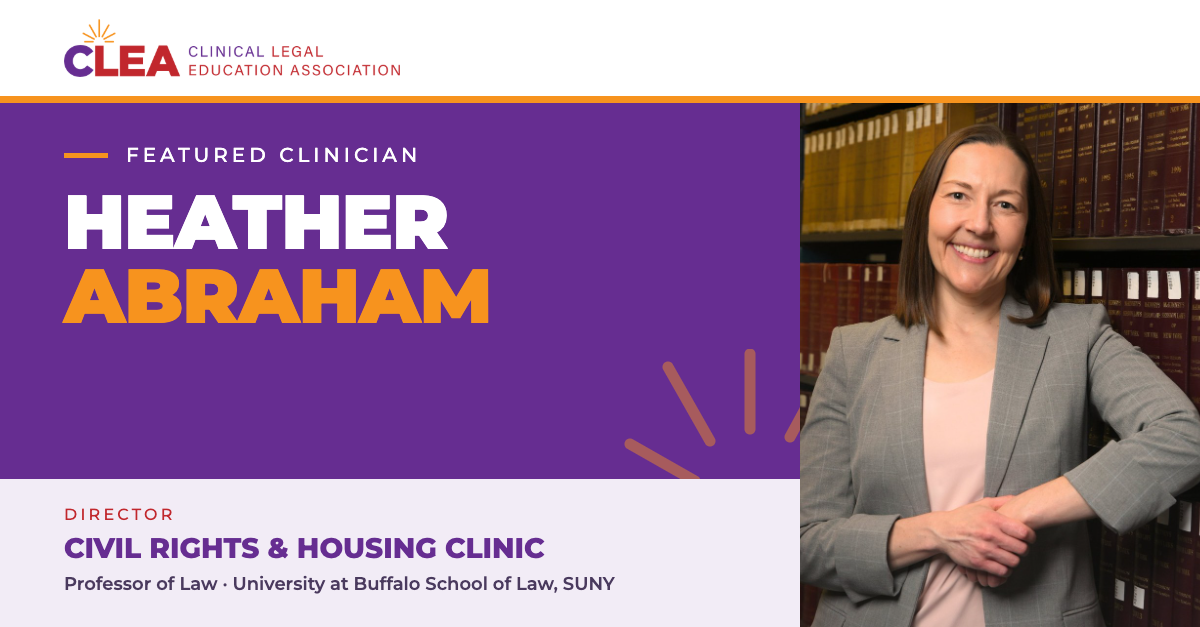
“I don’t want to simply tell students what to do.”
For Heather Abraham, that line sums up a way of teaching built on trust. As director of the Civil Rights and Housing Clinic at SUNY’s University at Buffalo School of Law, she asks students to take real ownership of their cases and to find their own lawyering identities. She backs that independence with frequent, careful feedback that names what each student does well and where they can grow.
The results reach well beyond the classroom. Since Heather joined UB Law in 2020, clinic students have represented hundreds of clients at no cost. They have helped many tenants avoid eviction and possible homelessness, and helped others defend their civil rights through litigation in fair housing and voting rights.
Heather’s path to housing justice began as a research assistant to Prof. Myron Orfield at the University of Minnesota Law School. Before UB, she represented low-income renters facing eviction as a legal services attorney, clerked in the U.S. District Court for the Western District of Michigan and the U.S. Court of Appeals for the Sixth Circuit, and supervised students in Georgetown Law’s Civil Rights Clinic.
That thread runs through her scholarship today: fair housing, residential segregation, civil rights, and access to justice. In a region with high levels of racial and ethnic residential segregation, the work has direct local stakes. Her work was recently featured in a Jotwell review, which describes her scholarship as embodying “the sort of practical, important work that often comes out of the clinical trenches.”
She brings that history into her teaching too, recently leading students on a Buffalo Civil Rights History Tour that included the Michigan Street African American Heritage Corridor and the site of an early public housing complex built when public housing was explicitly segregated.
This fall brings two milestones. Heather has been promoted to professor of law with tenure, and she has been selected to join the Clinical Law Review Board of Editors, with her term beginning in January 2028. Colleagues describe her as someone who connects scholarship and teaching with service. If you’re thinking through housing justice, residential segregation, civil rights advocacy, or clinical teaching, she’s a great person to brainstorm with. Look for her at the next AALS conference or reach out before then at habraham@buffalo.edu.